This book documents the legal proceedings of the December 1949 Khabarovsk trial in which twelve members of the Japanese Army's covert biological warfare Unit 731 were prosecuted for their war crimes. The trial sought to hold key leaders in Japan's bio-weapons program accountable for atrocities after WWII.
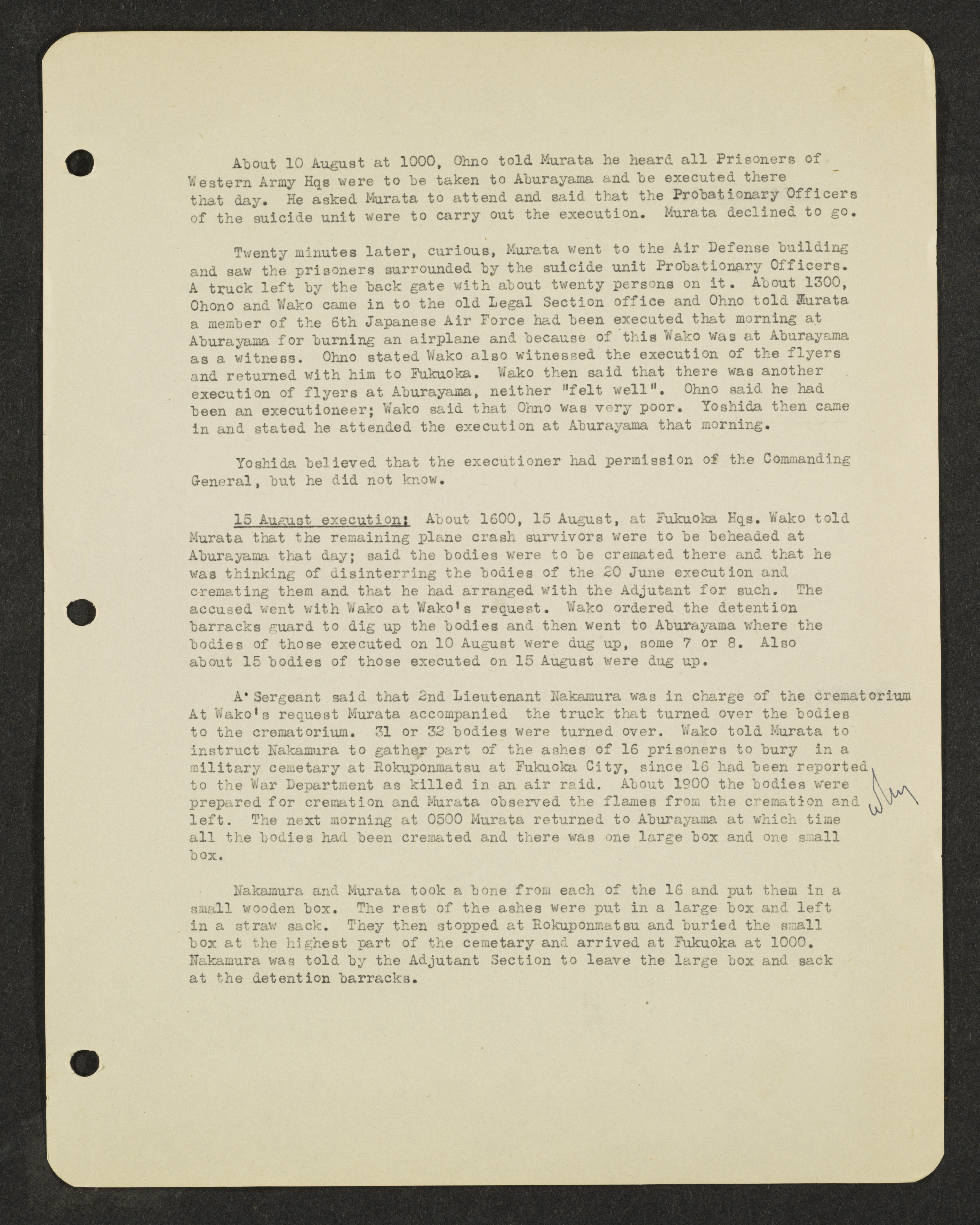
This collection contains over 2,000 pages of research and case files compiled by chief prosecutor Paul K. von Bergen for Class B and C war crimes trials held in Yokohama, Japan from 1946-1949, focusing on the mistreatment and unlawful execution of American POWs by lower-ranking military and civilian personnel. Operating under U.S. authority concurrent to the IMTFE in Tokyo, the materials include typed notes, accused statements, witness testimony, diagrams, and photographs related to the abuse and killing of prisoners in Fukuoka by personnel at Western Army Headquarters and Kyushu Imperial University medical school.
David Nelson Sutton served as associate counsel to the International Prosecution Section (IPS) of the IMTFE. This collection contains briefs, correspondence, affidavits, photographs, newspaper clippings, and other court documents relevant to Sutton’s IPS service and the IMTFE. Sutton's papers include documents from his travels through China in 1946 to investigate the Nanking Massacre.
Calhoun W. J. Phelps served as the assistant chief of the documents division for the International Prosecution Section (IPS) of the IMFTE. This collection, bound in two scrapbooks, consists of official IPS documents, newspaper clippings regarding the trial, photographs and ephemera collected by Phelps during his tenure on the IPS team, and documents on the formation and structure of the trial teams and the tribunal itself.
The George Carrington Williams Papers document his work on the International Defense Section (IDS) of the IMTFE from 1945 to 1948. A 1942 graduate of the University of Virginia School of Law, Williams was assigned to the defense of Naoki Hoshino, who was the chief civilian official in the Japanese government for Manchuria. Hoshino also served as President of the Planning Board from 1940-1941 and Chief Cabinet Secretary from 1941-1944.
International Military Tribunal for the Far East: This collection contains prosecution documents, investigative reports, trial records, and newspapers related to John H. Morgan's role as Chief Interrogator preparing cases against Japanese leaders tried for war crimes in the International Military Tribunal for the Far East.
The Greenbrier Hotel Mission: These papers document Morgan's work as an FBI agent overseeing the confinement of Axis diplomats from North and South America detained at resorts in West Virginia and Virginia in exchange for American prisoners abroad during World War II.
The papers of Frank S. Tavenner, Jr. include over 20,000 pages of Tavenner’s personal papers regarding the International Prosecution Section (IPS) of the IMTFE. Tavenner served as the Acting Chief Prosecutor while Joseph B. Keenan was in the United States and had a leading role in developing IPS arguments. This collection consists of Tavenner personal files (26 boxes) as well as his set of official IMTFE records (195 boxes), from 1945 to 1948.
This case involved the unlawful execution of American POWs at Fukuoka's Western Army Headquarters; dozens of defendants stood accused of carrying out extrajudicial killings of Dolittle raiders and other prisoners at the facility.
Over 25 Japanese personnel, including doctors and professors, faced allegations of conducting medical experiments on POWs without consent at Kyushu Imperial University, including exposing prisoners to contagious diseases and performing vivisections without anesthesia.
This case centered on denying POWs adequate food, shelter, and medical care at Fukuoka Camp #3 in violation of international law regarding prisoner treatment.
Matsuki and other camp personnel faced justice for overseeing squalid conditions, starvation, torture, and unlawful executions of Capt. Floyd Hall and other Allied pilots held at Fukuoka Camp #25.
Camp officials and guards stood trial for the systematic torture, abuse, and wrongful killings of multiple American POWs at sites like Fukuoka Camp #3 between 1942-1945.